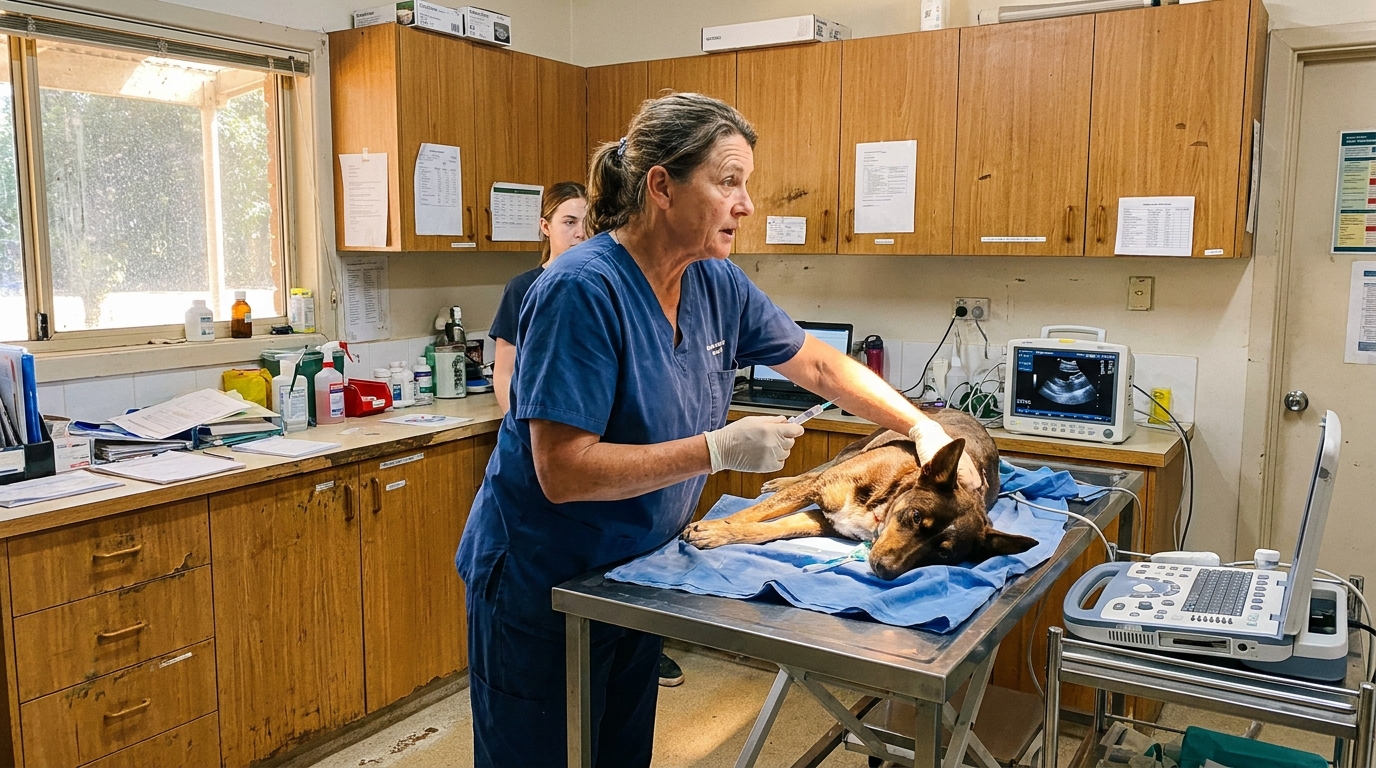
RxWorks for vet clinics in 2026: what it does, why long-tenured AU and NZ practices stay on it, and the review engine that pairs with it
RxWorks has been quietly running independent vet practices across AU and NZ for two decades. Owned by Covetrus now, it's the PMS where you'll often find long-tenured clinics with a decade-plus of patient history — and no good reason to migrate. The pitch isn't "shiniest cloud system on the market"; it's "rock-solid practice management that's been doing the job since before your kelpie was a puppy." This piece walks through what RxWorks actually does, why long-running practices stay on it, where its age shows, and how X18 reaches into the database to deliver review velocity that finally matches the reputation those practices have built.
RxWorks is the long-tenure AU/NZ vet PMS that runs many regional and suburban independent clinics. Strong on database depth, recall logic, and the kind of stability that comes from twenty years of refinement. The interface shows its age compared to ezyVet, but the practices that stay on it stay for good reasons. X18 integrates via scheduled database polling — every day's consults are read, and review requests fire in the practice's voice within hours. No staff effort, 6×–13× more reviews, often producing in months what the practice took years to accumulate organically.
What RxWorks is, in one paragraph
RxWorks is a long-running practice management system for veterinary clinics, primarily used across AU and NZ, now owned by Covetrus. It handles appointments, patient records, dispensary, recalls, invoicing, and the operational depth a multi-decade independent practice has built up. It's installed locally (or on a hosted server), not browser-native, and the interface shows its lineage — but the database underneath is mature, well-indexed, and trusted by some of the longest-tenured clinics in the country.
What RxWorks does well
1. Database stability
A clinic with fifteen years of patient history needs a PMS where that history is intact, indexable, and queryable. RxWorks delivers that. Migrations off RxWorks are rare partly because the data depth makes the migration cost real.
2. Recall and reminder logic
RxWorks's recall engine is one of the most flexible in the AU/NZ market — multi-condition rules, owner preference handling, and species-specific templates all work without third-party plugins. Long-tenure practices often have years of carefully configured recall logic that nobody wants to rebuild from scratch.
3. Operational depth
Specialist features that show up in practices over time — boarding modules, multi-vet rosters, complex billing rules, lab equipment integration — RxWorks accommodates them. The depth isn't pretty, but it's there.
4. Australian and New Zealand practice support
Localised pricing, recall types, and regulator-aware features for AU/NZ clinics. The tax handling, compounding pharmacy logic, and government-form integration are tuned to the local market.
5. The "nothing's broken" factor
For practices where the PMS isn't a problem, switching is risk. RxWorks's core stability — appointments don't disappear, invoices don't double-charge, recalls don't fire wrong — is the quiet feature that keeps clinics on it for decades.
Why long-tenured practices stay on RxWorks
Three reasons, often in combination:
- Migration cost is real. A practice with fifteen years of patient records, dozens of complex recall rules, and hundreds of templated documents has a meaningful one-off cost to leave RxWorks. Many practices don't see the upside outweighing it.
- Staff have learned the workflows. The receptionist who's been there twelve years knows where every screen is, every shortcut, every quirk. Retraining the team for marginal improvement is a real productivity hit.
- "It's not the PMS that's stopping us growing." Owner-operators who've already done the work to identify their actual growth constraints (review velocity, GBP rank, hiring) often realise the PMS isn't on the list. RxWorks isn't holding them back from those things.
On RxWorks for years? Reviews are the easier upgrade.
No PMS migration needed. X18 plugs into your RxWorks database via a scheduled poll, no disruption to the practice — and your team doesn't change a single workflow.
Where RxWorks's age genuinely shows
The honest list, said with respect to the practices that have built decades on it:
- The interface isn't modern. Compared to a cloud-native UI, RxWorks looks like the 2010s. New staff used to consumer apps will need a couple of weeks to acclimate.
- Mobile and remote access are limited. RxWorks is fundamentally a server-installed product. Cloud and mobile come via separate hosting layers, not as native design.
- The API surface is narrower. Modern integrations require workarounds — direct database access (which X18 uses) rather than well-documented REST endpoints.
- Vendor roadmap is slower. Under Covetrus, the development cadence is more conservative than ezyVet or some of the newer cloud-native vendors. Big-feature releases come less often.
None of those are deal-breakers for the practices RxWorks serves best. They are the trade-offs that make sense in context.
How X18's review engine plugs into RxWorks
RxWorks's database depth makes the integration straightforward, even though the API surface is narrower than ezyVet's:
The trigger: X18 polls the RxWorks database on a scheduled interval — typically once per day, configurable. Each poll surfaces the consults closed since the last run.
The decision: Same AI psychology engine that runs across the X18 customer base. Wording, timing, and channel tuned per consult type, per region, per clinic profile.
The send: Personalised SMS or email from the practice, scheduled to land within hours of the consult — not days later when the moment has passed.
The flow: one tap to Google, plus a direct feedback line so concerns reach the practice as a conversation.
"We've been on RxWorks for sixteen years. We weren't going to migrate the PMS just to chase reviews. When X18 said they'd plug into the database directly and we wouldn't change a workflow, that's when it actually became viable."
A long-tenure practice owner in our customer base · specifics shared on a strategy call
What changes when reviews run alongside RxWorks
RxWorks practices tend to be the ones with the largest gap between reputation and review profile. The pattern across the customer base:
- The decades-of-reputation finally show up on Google. Practices that took twenty or thirty years to earn a few hundred organic reviews see the equivalent in 1–2 months. Two of the longest-tenured clinics in the X18 customer base saw their review count more than double in the first three months.
- Local-pack rank reorders quickly. Long-tenure clinics often have more reviews than the corporate chains nearby — but those reviews are five years old. Velocity flips the recency signal almost overnight.
- Existing systems stay untouched. The receptionist's day, the vet's workflow, the recall logic — none of it changes. The review engine runs alongside, not on top.
Frequently asked questions
Does X18 require any changes to our RxWorks setup?
No structural changes. We configure read access to the consult and client tables — your team's day-to-day RxWorks experience is identical.
Will the integration affect RxWorks performance?
No. The database poll runs at a low-priority interval and reads only the consults closed since the previous poll. Standard practice; no measurable load.
What about hosted RxWorks versus on-premise installations?
Both are supported. The integration mechanism adjusts to the hosting model; setup time and ongoing operation are equivalent.
Will our long-tenure clients respond to a review SMS?
Yes — and disproportionately well. Long-tenure clients already feel a relationship with the practice; a personalised request from the vet they've seen for years has a much higher response rate than a cold-prompt from a new clinic.
If we eventually migrate from RxWorks, does the X18 setup move with us?
Yes. Voice tuning, message templates, and historical review data all transfer to the new PMS integration. No re-onboarding; the engine just switches input source.
Long-tenure practice on RxWorks? Let's let the reviews catch up.
Fifteen minutes. We'll look at your current review profile against your actual reputation, walk through how the database integration works, and show you the 60–90 day picture for closing the gap.
Book a 15-minute strategy call →
Leeor Meirovitz
Leeor's spent the last few years inside hundreds of independent vet clinics across the AU, NZ, UK, US, CA, TH, and PH markets — what actually moves Google ranking, what corporate chains can't replicate at the per-location level, and how the silent 99% of happy clients become the practice's loudest reviewers. He writes the way he talks at strategy calls: friendly, specific, and slightly opinionated.