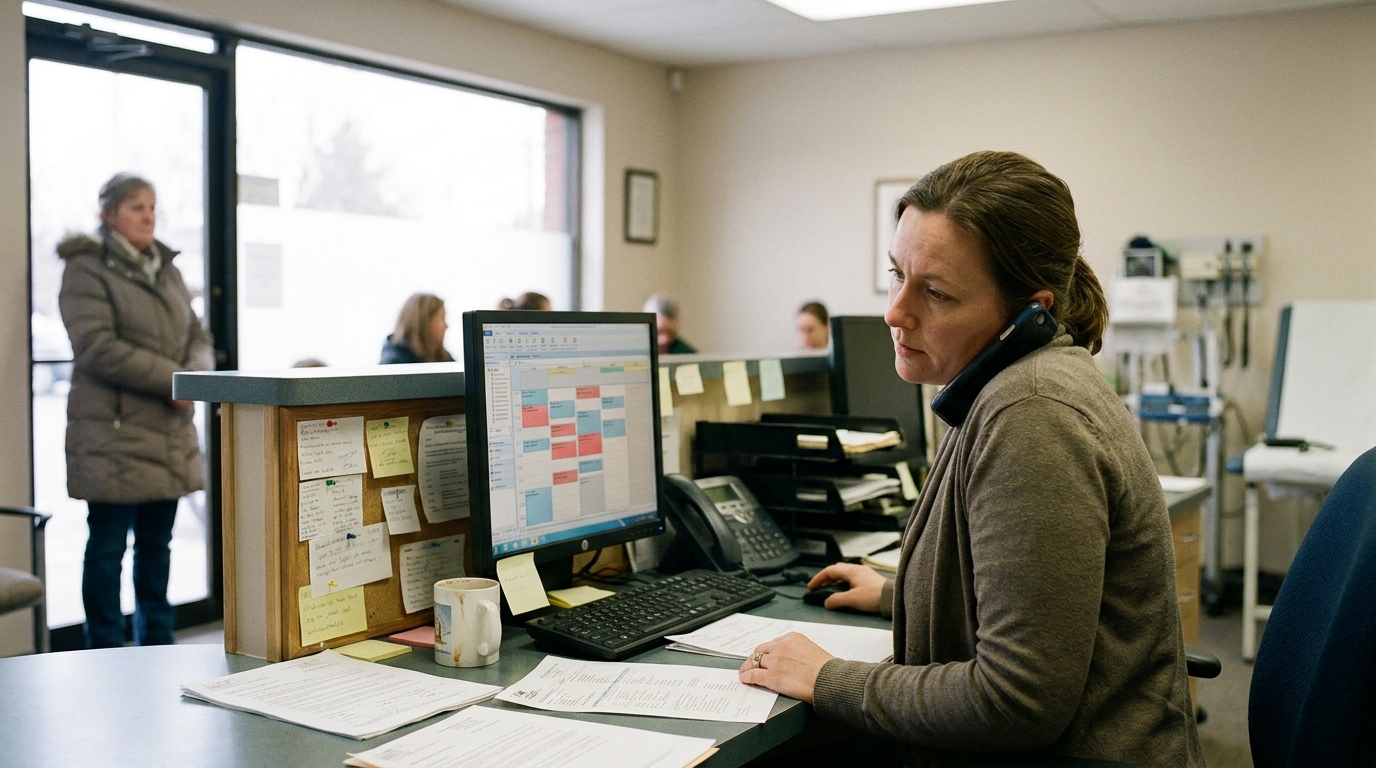
Same-day GP appointment search: what patients see when they're sick today
The patient who needs a doctor today isn't choosing a practice. They're choosing whoever looks most likely to fit them in — and that call gets made in under a minute, on three things visible without opening a single website: whether you read as open, what you're rated, and how recently anyone said anything about you.
TL;DR
The same-day searcher is the sharpest test a GP profile ever faces: no referral, no loyalty, no research time — just an "open now" filter, a star rating and a date on your newest review. Practices with accurate hours and reviews arriving weekly win these calls; practices with a stale profile get skipped regardless of how good the medicine is. And the sick-today patient isn't a one-off appointment — handled well, they're a registration that lasts years. Across the X18 customer base, practices asking every eligible patient the same way see 6 to 13× their previous monthly review volume, and profiles holding 4.8 stars or better average 1.8× quarterly growth in new-patient appointments.
What does a patient who needs a GP today actually search?
Not what your website is written for. Nobody types "comprehensive family medicine [suburb]" while sitting on the edge of a bed at 7:30am with a sick five-year-old. They type the constraint, and the constraint is time:
- Availability-led. "gp near me open now", "same day doctor appointment [suburb]", "doctor open today", "gp open Saturday morning".
- Symptom-led. "chest infection doctor near me", "how do I see a gp today", "urgent gp appointment", "kids doctor near me open".
- Errand-led. "medical certificate same day", "doctor for work certificate near me", "script renewal doctor today" — small jobs with hard deadlines, and the searcher will ring four practices until one says yes.
Every one of those lands in the same place: the map pack, three results, a few seconds of scrolling each. The mechanics of how Google picks those three sit in local SEO for GP practices. What this article is about is narrower and more brutal — what happens in the ten seconds after the three results appear.
What the same-day searcher sees before they ring anyone
Look at your own profile on a phone, because that's the only surface that matters here. What's on screen is your name, your star rating, your review count, one snippet of a recent review, an open-or-closed line, and a call button. That's it. No team page, no "established 1998", no list of the languages your GPs speak.
So the shortlist gets cut on the handful of signals that are readable at a glance. A 4.9 with 260 reviews and a comment from Monday reads as a practice that's busy and answering. A 4.5 with 60 reviews, newest from eighteen months ago, reads as a practice that may have half its GPs gone — and that's a fair thing for a patient to assume, because a live practice usually leaves a trail.
The practical version: in a same-day search you're not being compared on medicine. You're being compared on whether you look open, staffed and worth ringing first — and the date on your newest review answers that faster than anything else on the screen.
There's a second-order effect worth naming. The snippet Google chooses to surface is usually recent, which means your newest reviews are doing your advertising whether you planned it or not. If the last three people to write about you mentioned being fitted in the same day, that's what the next patient reads. If the last three mentioned the wait, that's what they read instead.
Why does availability decide the call more than distance?
Because proximity can't answer the only question being asked. A practice 400 metres away that can't see anyone until Thursday is worth less to this patient than one 4km away with a slot at 11am — and the searcher knows it, which is why they use the "open now" filter, and why they read the hours line before they read anything else.
That filter is unforgiving. If your Google hours say you close at 5pm and you actually run to 7pm two nights a week, you're invisible for every search after five on those nights. If your public-holiday hours aren't set, you're shown as open when you're shut — which produces the single most preventable negative review in general practice, the one from someone who drove there with a sick toddler and found the door locked.
- Regular hours per day, not a single blanket range. Late nights and Saturday mornings are exactly the slots this cohort searches for.
- Special hours for every public holiday — set the year ahead once, in one sitting, rather than remembering each time.
- A booking link that shows real availability. A link that opens to "next available: 9 days" costs you the call. A link that shows this afternoon wins it.
- Telehealth listed as its own service, because for a script renewal or a certificate it's the fastest yes you can give.
None of that is marketing. It's data hygiene — and it's the part of visibility a practice manager can fix in an afternoon without anyone's approval.
Want to see what the sick-today patient sees?
On a 15-minute call we'll pull your Google profile next to the three practices you're compared against in the local pack — rating, review count, arrival rate, hours accuracy and how recent the newest review is — and show you where the same-day searcher is dropping you.
Book a 15-minute strategy call →Is your profile answering "can I be seen today?"
Most GP profiles are built for the patient who's choosing a practice for the next decade, and quietly fail the one who needs help before lunch. Six fixes, none of which need a web developer:
- Put the words patients use in your services list. Same-day appointments, walk-in, telehealth consults, medical certificates, script renewals, after-hours — not "general practice services".
- Get hours exactly right, holidays included. See above. This is the highest-return half hour available to you.
- Say what you hold back. If you keep same-day slots for acute presentations each morning, put it in your profile description and pin a Google post saying so. It answers the exact question being typed.
- Write one page on your own site about being seen today. What you keep free, how to get in, what to do if you can't, your number near the top. It captures symptom-shaped searches your services pages never will.
- Reply to reviews within a couple of days. Reply timing reads as responsiveness to a scanning patient — and the privacy traps specific to general practice are covered in replying to patient reviews without confirming anyone's a patient.
- Keep reviews arriving. Everything above is a one-off. This one is the engine, and it's the only item your competitors can't copy in a morning.
Look, we get it — a practice with a full book doesn't feel like it has a visibility problem. The same-day searcher is the tell, because they have no loyalty to anybody. If you're not winning them, your growth depends entirely on patients you already have. Your billing model belongs in this picture too, and it's its own piece of work: what your reviews say about bulk billing covers why that turns up in almost every GP profile.
The sick-today patient is a registration, not a visit
Here's the part that changes how the numbers look. The same-day patient arrives as a single item on a Tuesday — and then, if the appointment goes well, becomes something much larger. They needed a GP and didn't have one. You solved a real problem at short notice, on a day when nobody else would. That's how practices acquire families.
What we see across the customer base is that same-day and urgent-search patients register as ongoing patients at a noticeably higher rate than patients who arrived from a general "gp near me" search, and — this is the compounding bit — they write more specific reviews. A review that says "rang at 8am with a sick kid and they fitted us in before nine" is worth more than fifty that say "lovely practice", because it's written in the exact language the next same-day searcher is typing. The cohort feeds itself.
What the base shows: roughly 99% of satisfied patients never leave a review unprompted, while frustrated ones self-motivate. Practices that ask every eligible patient the same way see a 6 to 13× lift in monthly review volume, those maintaining 4.8 stars or better average 1.8× quarterly growth in new-patient appointments, and a universal private feedback route is associated with an average 94% reduction in negative public reviews. One anonymised outer-suburban practice in our base moved from the mid-4.5s to 4.9 while adding a bit over 200 reviews across a few months — the shortlist maths changed, and same-day calls were the first thing the reception team noticed.
How do you ask a same-day patient for a review without it feeling wrong?
By not treating them as a special case in the way most practices assume. The model that works — and the only one that's defensible — is the one we run everywhere: every eligible patient is asked the same way, at a sensible moment, with a private feedback route offered to all of them alongside it. Sentiment never decides who gets asked. Filtering by how happy someone seems is both a compliance problem and a bad way to build a profile anyone should trust.
What does change for this cohort is timing and eligibility:
- Wait for the outcome, not the appointment. Someone still unwell has a half-formed opinion. A few days later, when the antibiotics have worked or the certificate did its job, the review writes itself.
- Exclude what should be excluded. Serious diagnoses, mental-health presentations, child-protection matters, bereavement-adjacent visits and anything with a complaint in progress stay out — configured once at setup so nobody's making that judgement at a busy front desk. The full map is in who a GP practice should never ask for a review.
- Send it as the practice. A message that looks like it came from your rooms gets opened. One that looks like it came from a platform gets binned.
- Offer the private door to everyone. Patients with a fixable frustration — the wait, the parking, a billing surprise — take it, and your practice manager hears about it the same day instead of reading it in public a week later.
One boundary specific to Australian practice: asking patients for reviews is fine, but as a registered health service you can't use testimonials in your own advertising. Patient-written reviews living on your Google profile are a different thing from you republishing them as marketing claims on your website or in an ad. Keep the ask clean and let the profile do its work where patients are already looking.
What is same-day visibility worth to a GP practice?
Run this with your own figures rather than ours. Start with the same-day and urgent calls you'd receive sitting in the top three of that map pack instead of fifth — for most suburban Australian practices that's a handful a week, not dozens. Assume a conservative share of them register as ongoing patients. Multiply by what a registered patient is worth to you across a few years of consultations, care plans and family members who follow them in.
For most practices, the annual figure is uncomfortable to look at, because the work standing between them and it is so ordinary: accurate hours, a page about being seen today, replies within two days, and a review ask that runs every day without anyone remembering to run it. That's the whole thing. The compounding lives in the consistency, not in any clever tactic.
You can see what a quarter of that looks like in the Melbourne practice local-pack case study, and how it connects to list growth in reviews as a new-patient channel. The wider approach sits in the GP practice library and on the Review Engine for GP practices. Happy to share specifics on a 15-minute strategy call →
Frequently asked questions
How do I rank for "gp near me open now"?
Three things, in order. Get your hours and special hours exactly right so you survive the "open now" filter at all. List same-day, walk-in and telehealth explicitly in your services with the words patients type. Then build review prominence — count, recency and arrival rate — because that's the ranking leg you fully control. Proximity you can't change, and categories are a one-off setup job.
Do Google hours really change how many calls we get?
More than most practices expect, because they're a filter rather than a ranking factor — if you're marked closed, you're not shown to that searcher at all, no matter how good your rating is. Practices running late nights or Saturday mornings without those hours set are invisible for the exact sessions they built to attract new patients.
Should we list telehealth as a same-day option?
Yes, and give it its own line rather than burying it in a description. For script renewals, certificates and follow-ups it's the fastest yes you can offer, it fills gaps in the book, and it converts a patient who'd otherwise ring the next practice on the list. Those consults are also eligible for a review ask on the same terms as any other appointment.
Is it appropriate to ask an acutely unwell patient for a review?
Once they're better, yes — and they're often the most motivated reviewers a practice has, because you helped on the day it mattered. What matters is waiting for the outcome rather than asking on the way out, and holding back the presentations that shouldn't be in the programme at all. That exclusion set gets configured once, not decided at reception on a busy morning.
Can we use patient reviews in our practice's advertising?
In Australia, no — testimonials about clinical care are restricted in advertising for registered health services, which is why you won't see us putting patient quotes on a practice website or in an ad. Asking patients for reviews is allowed and the reviews live on your Google profile, where patients are already searching. Keep the two things separate and you stay well inside the line.
How recent do reviews need to be to look active?
The useful benchmark is whether your newest review is from this month. A few arriving each week keeps the top of your profile permanently fresh, which is what the urgent searcher reads. A large stale total loses to a smaller live one in this cohort every time — total count still builds credibility, but recency is what gets you the call.
We hold same-day slots but nobody seems to know. What's the fix?
Say it in the three places this searcher looks: your Google profile description, a pinned Google post, and the first line of your "seen today" page. Reception should say it on the phone before anything else, too. Availability is the thing being searched for — leaving it out of the copy while your competitors say it plainly is the most common miss we see in general practice.
Be the practice they ring when it can't wait.
Fifteen minutes. We'll look at your profile the way a patient who needs help today sees it, compare it with the three practices beating you in the map pack, and map the fastest route to a profile that reads as open and answering — start with the GP practice library or the Review Engine for GP practices.
Book a 15-minute strategy call →
Leeor Meirovitz
Leeor's spent the last few years inside hundreds of independent vet clinics across the AU, NZ, UK, US, CA, TH, and PH markets — what actually moves Google ranking, what corporate chains can't replicate at the per-location level, and how the silent 99% of happy clients become the practice's loudest reviewers. He writes the way he talks at strategy calls: friendly, specific, and slightly opinionated.