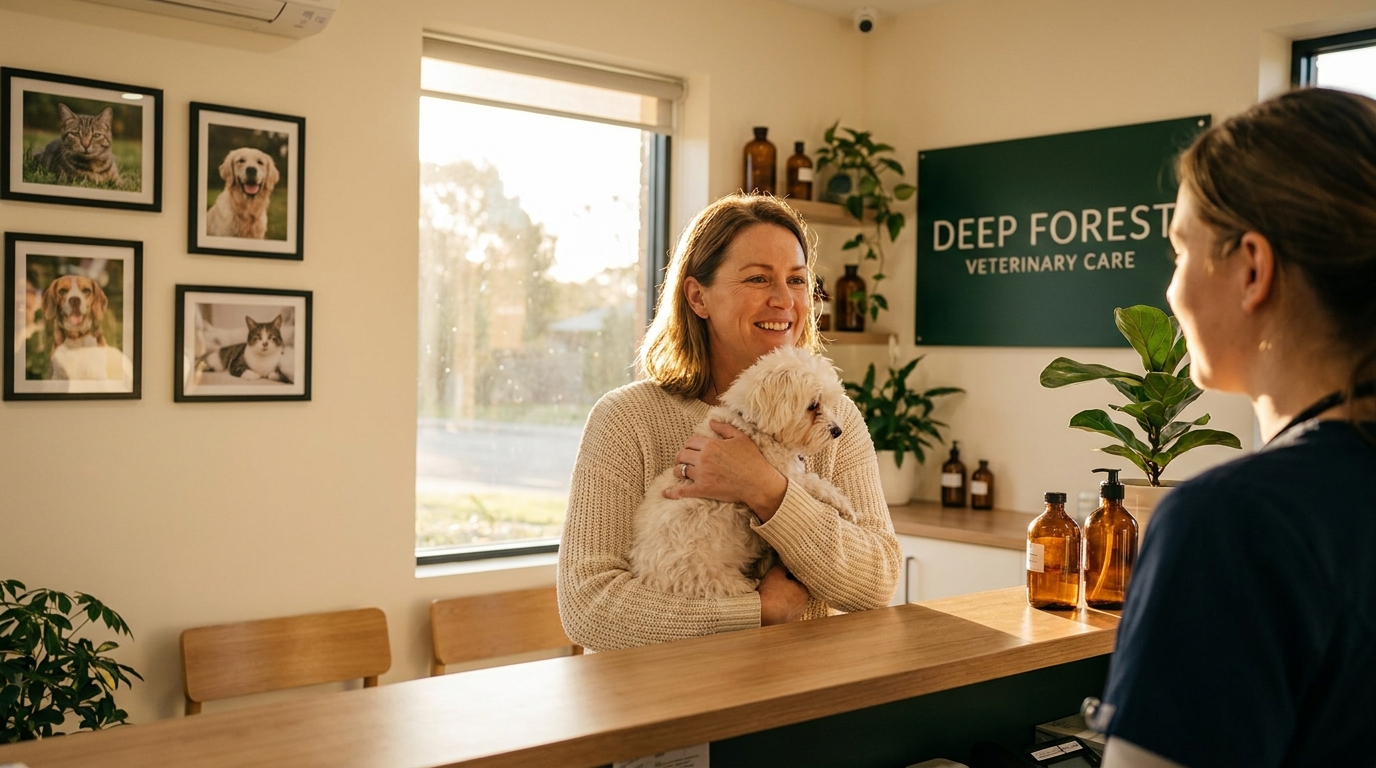
How a 30-year-old practice tripled monthly review velocity in two months
A long-running suburban veterinary practice — three decades of word-of-mouth, three generations of dog families, the same lead vet who delivered the family puppy fourteen years ago — looked at their Google profile in late 2025 and noticed something strange. Decades of trust, and 153 reviews. Younger clinics down the road were already at 400+. Here's what changed in the next eight weeks.
Where they started
Anonymised by location and identifiers per X18's editorial policy. The shape of the practice:
- Tenure: 30+ years operating from the same address
- Scale: 4 vets, 6 nurses, ~300 active clients/month
- PMS: ezyVet (cloud, ~3 years on platform)
- Starting Google profile: 153 reviews · 4.6 stars · ranked #6 in their suburb's local pack
- Reviews per month, prior 12 months: ~4–5 (no systematic ask, occasional pamphlet on the front desk)
The practice owner's frustration on the discovery call: "We've been here forever. We're the trusted clinic in this suburb. But on Google we look like the new place around the corner has more momentum than us, because they do."
That's the structural problem long-tenured practices share. Decades of trust earns repeat clients. It doesn't earn recent reviews. And the local pack reads recency as a signal.
The first ten days
After kickoff, the X18 integration to ezyVet went live and started routing post-consult prompts. The shape of week one:
- Day 1–3: 6 new public reviews, all 5-star, all from existing clients seeing the message for the first time
- Day 4–7: Another 11 reviews. The practice manager messaged Leeor: "Is this normal? They're coming in faster than we can read them."
- Day 8–10: 14 more. The team started reading new reviews aloud at the morning huddle. One vet said it was the first time they'd seen a client write that they'd brought their dog there for ten years.
By the end of week two, the cumulative count was 48 new reviews — already ten months' worth of organic accumulation, in two weeks of operation.
The two-month outcome
Plus 17 negative reviews caught privately by the resolution flow over the same period — phoned back by the practice manager, listened to, fixed where possible. None hit Google.
By month two the practice had moved from #6 in their suburb's local pack to #1. The 30 years of trust finally had a Google footprint that matched.
What the team noticed first
The numbers aren't the part the practice owner brought up first when we caught up at the 8-week mark. The thing they wanted to talk about was the team.
"Reception used to be the place where complaints landed first. Whenever something went wrong, they were on the phone with the unhappy client before any of us had heard about it. After a while, that wears people down."
"Now they come in to a feed of clients writing about how kind they were, how patient with the elderly cat lady, how quickly they got someone seen. The morning huddle starts on a different note."
That morale-shift is the thing the platform-stat (87% of clinics report better team mental health) actually feels like at the clinic level. It's not a separate intervention — it's a side effect of the asymmetry flipping.
Want to see this clinic's live before/after?
A 15-minute strategy call. We'll show you the exact Google Business Profile, walk through what the engine does for practices like yours, and answer anything you'd want to know.
Book a 15-minute strategy call →
Leeor Meirovitz
Leeor's spent the last few years inside hundreds of independent vet clinics across the AU, NZ, UK, US, CA, TH, and PH markets — what actually moves Google ranking, what corporate chains can't replicate at the per-location level, and how the silent 99% of happy clients become the practice's loudest reviewers. He writes the way he talks at strategy calls: friendly, specific, and slightly opinionated.