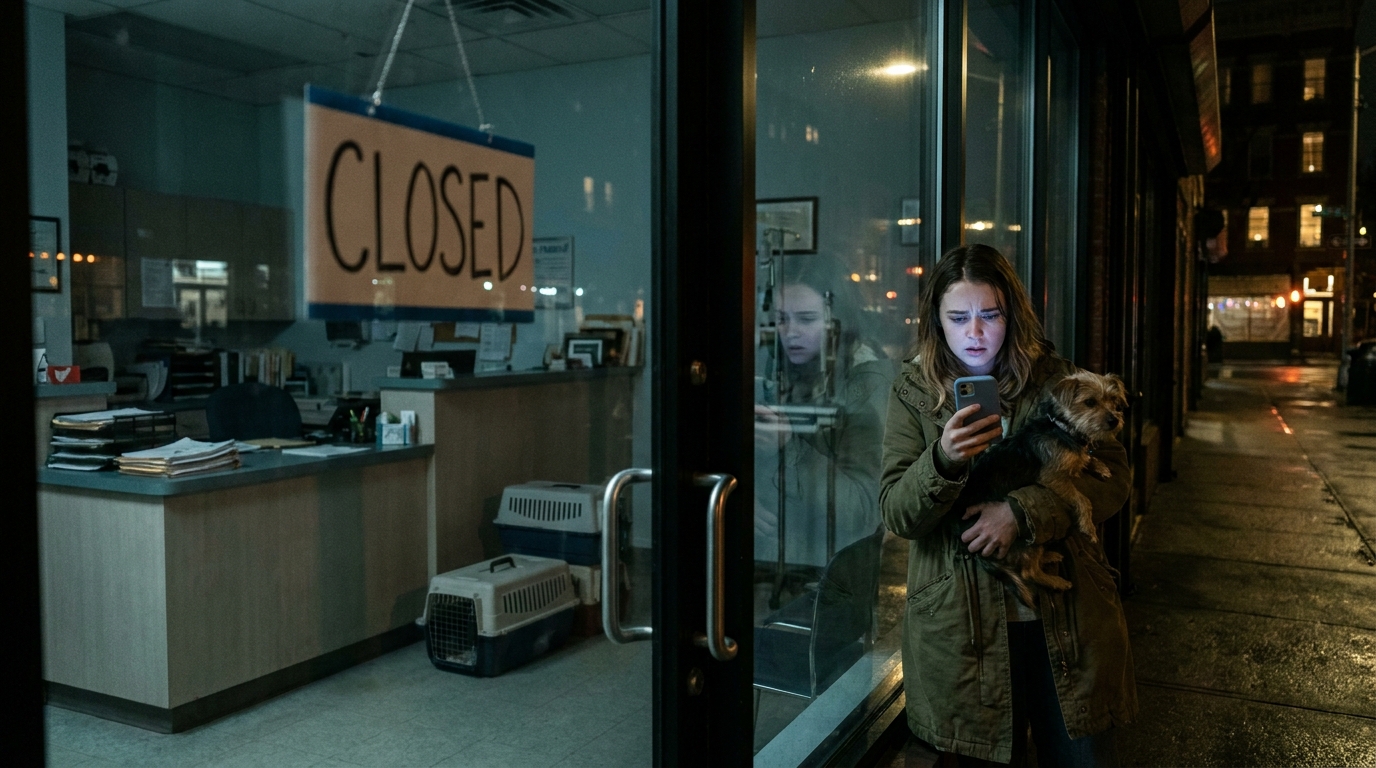
What pet owners see when your clinic is closed — and why it costs you Monday's bookings
The most valuable search anyone runs about your clinic happens when you're closed. It's 9:40pm, a dog has eaten something it shouldn't have, and an owner who has never used your clinic is typing "vet near me open now" with one hand. You're shut — that's fine, you're allowed to be shut. What isn't fine is that your profile in that moment usually decides who they book with for the next ten years.
TL;DR
After-hours searches are the highest-emotion moment in the whole category, and most of them are run by people who aren't your clients yet. They can't book you tonight — but they're forming an opinion about you tonight. The clinics that win Monday morning are the ones whose profile answers the after-hours question honestly (hours, emergency referral, what to do right now) and whose reviews look recent enough to read as a going concern. Across the X18 customer base, clinics collecting reviews consistently see 6 to 13× their previous monthly volume, and 99% of the happy clients who could be writing those reviews never do it unprompted.
What do pet owners actually search at 9pm?
Not what you'd guess from your daytime enquiry log. The after-hours searcher isn't comparing prices or reading your team page — they're triaging. The searches cluster into three shapes, and each one behaves differently:
- The panic search. "emergency vet near me", "vet open now", "24 hour vet [suburb]". Something is happening right now. This person will drive 40 minutes and pay whatever it costs.
- The symptom search. "dog vomiting after eating grass", "cat not eating 2 days", "is my dog limping serious". They're deciding whether tonight is an emergency at all — and roughly two-thirds of the time they'll conclude it can wait until morning.
- The plan-ahead search. "vet [suburb]", "best vet near me", run at 10pm on a Sunday because they've decided to sort it out tomorrow. This is a booking that hasn't happened yet.
Notice that only the first one is genuinely an emergency-clinic query. The other two are yours — and both are being answered right now by whatever Google decides to show when your door is locked and your phone rolls to a recorded message.
What Google actually shows when your clinic is closed
Two things change after hours, and both work against a clinic that hasn't thought about it. First, Google applies an openness filter to a chunk of these searches — "open now" is often implied by the phrasing even when it isn't typed, and the map pack reshuffles toward whoever is actually open. Second, your listing picks up a red "Closed" line and, if you've never set them, a set of hours Google isn't confident about.
What the searcher sees is a stack of three results where the emergency centre 25 minutes away looks alive and answering, and you look — well, shut. That part is unavoidable and honest. The part that's avoidable is everything sitting underneath it: whether your profile explains what to do tonight, whether your last review is from this month or from 2023, and whether the star rating next to your name clears the bar they've unconsciously set.
The practical version: you're not competing for the 9:40pm consult. You're competing to be the clinic they remember at 8:05am — and that's decided entirely by how your profile reads while you're asleep.
Why the after-hours search decides next week's routine bookings
Here's the pattern we see most often across the customer base: a clinic's new-client calls on a Monday correlate less with what happened on Monday and more with what was visible over the weekend. The searching happens in the panic window; the booking happens two days later, when the crisis has passed and the dog is fine and the owner thinks — right, we should actually have a vet.
And they don't search again from scratch. They go back to what they already looked at. If your clinic came up on Saturday night with 340 reviews, a 4.9 rating, three replies from the practice in the last fortnight and a line explaining who covers after-hours in your area, you're the one they call. If you came up with 61 reviews, the newest from eighteen months ago, and no after-hours information at all, you're not the one they call — even if you're closer, cheaper and clinically better. That last part is the frustrating bit, and it's worth saying plainly: this is a visibility gap, not a quality gap.
The same mechanic is why long-established clinics get quietly overtaken. We covered the underlying maths in how the Google local pack actually ranks vet clinics — prominence is the one leg of the ranking stool you fully control, and recency is weighted far more heavily inside it than most owners expect.
Want to see what your clinic looks like at 9pm on a Saturday?
On a 15-minute call we'll pull your Google profile the way an after-hours searcher sees it — hours, closed-state messaging, review recency, and the three nearest clinics you're being compared against — and show you what's costing you the Monday call.
Book a 15-minute strategy call →What should your Google profile say if you're not open 24/7?
Most independent clinics aren't 24/7 and shouldn't pretend otherwise — the honest answer converts better than the vague one, because a worried owner at 9pm wants a decision, not a brochure. Six things to have in place, none of which take longer than an afternoon:
- Accurate hours, including public holidays. Google downgrades confidence in listings whose hours look stale, and an owner who drives to a locked door at 8am on a Monday public holiday leaves a one-star review about it. That's the cheapest negative review in the world to prevent.
- A closed-state answer. Use your profile description and a Google post to say who covers after-hours in your area and what to do tonight. Naming the emergency centre you refer to doesn't send business away — it's the single most trust-building thing a closed clinic can do.
- An after-hours page on your own site. One page, plainly titled, with the emergency centre's number, your own hours, and a short "is this an emergency?" triage list. It answers the symptom searches, and it gives Google something to match against the phrasing people actually use.
- A phone message that helps. If your out-of-hours recording just says "we're closed, call back tomorrow", you've wasted the one moment you had someone's full attention. Give the emergency number first, then your hours.
- Recent reviews. More on this below — but the review dated last week does more work at 9pm than any amount of website copy.
- Replies on the profile. A practice that answers reviews within a couple of days reads as a practice that answers phones. Your reply timing is a live-ness signal to both Google and the person reading.
Look, we know how unglamorous that list is. But it's the difference between being the clinic someone bookmarks in a panic and the clinic they scroll past — and none of it requires a marketing budget, just a decision that someone owns it.
Why recent reviews carry the after-hours decision
In daylight, a pet owner choosing a clinic has time to ask a neighbour, look at your website and think about parking. At 9:40pm they have none of that, so they fall back on the fastest available proxy for "is this place any good and still running properly": the rating, the number next to it, and the date on the most recent review.
That last signal is the one clinics under-rate. A profile with 400 reviews whose newest is from two years ago reads as a clinic that had a good run once. A profile with 180 reviews where four arrived this month reads as busy, current and staffed — which, at 9:40pm, is exactly the question being asked. Recency is doing emotional work, not just algorithmic work.
What the base shows: about 99% of happy clients never leave a review unless they're asked properly — while the rare unhappy one always finds the form. Clinics that start asking every eligible client the same way see 6 to 13× their previous monthly review volume, and practices holding 4.8 stars or better average 1.8× quarterly growth in new-client appointments. One anonymised regional clinic in our base went from roughly 240 reviews to over 600 in ten months — the equivalent of a decade of organic collection, arriving in under a year.
The compounding matters here more than the headline number. Every new review resets the recency clock, nudges prominence in the local pack, and makes the profile read as current the next time someone panics at 9pm. Two of your competitors are probably sitting on profiles that haven't moved in six months — that's the gap you're closing.
Which clients should you ask after an emergency-adjacent visit?
This is where it gets delicate, and where a lot of generic review software gets it badly wrong. The right model is the one we run across every niche: every eligible client gets asked the same way, at a sensible moment, with a private feedback option offered to everyone alongside it. Sentiment never decides who gets asked — that's both a compliance problem and, frankly, a dishonest way to build a profile.
What does change by visit type is eligibility and timing. In a clinic's week, the after-hours-adjacent visits break down roughly like this:
- The Monday-morning follow-up of a weekend scare. The dog is fine, the owner is relieved, and you're the practice that sorted it. Ask a day or two after the recheck — this is one of the warmest cohorts in the whole clinic.
- The referred-back patient. Seen at the emergency centre overnight, back with you for ongoing care. Ask after the care is settled, not on the day of handover.
- The genuinely bad outcome. Excluded, permanently and automatically. Euthanasia, a loss, a critical case that didn't end well — nobody who works in a clinic needs that explained, but the automation needs to know it, which is exactly why the exclusion set is configured once at setup rather than remembered by a stressed receptionist.
- Routine daytime work. The bulk of your volume, and the bulk of your reviews. The timing map by consult type is in when to ask for a review after a vet consult.
The private feedback route matters most in this category precisely because emotions run high. Someone whose weekend was frightening and expensive may want to tell you something before they tell the internet — and across practices running a universal private channel alongside the ask, negative public reviews drop by an average of 94%. Nobody's being silenced; they're being answered faster.
What is the after-hours gap actually worth?
Run your own numbers rather than ours — but here's the shape of it for a typical suburban Australian clinic. Say the closed-hours and weekend searches in your catchment send you three genuine new-client enquiries a week that you currently lose to a better-looking profile. At an average client lifetime value in the A$4,000–6,000 band for a small-animal practice, and being conservative about how many of those enquiries would have converted, you're looking at a meaningful five-figure difference over a year from a set of fixes that cost an afternoon plus a working review process.
There's a second-order effect worth naming too: the after-hours searcher who becomes a client tends to arrive loyal. They found you at their worst moment and you were the one who looked capable. Those clients stay, they refer, and — once you're asking properly — they review.
You can see what the compounding looks like over a longer run in what happened when a 30-year practice turned on review velocity, and the wider playbook sits in the vet playbook library and on the Review Engine for vet clinics. Happy to share specifics on a 15-minute strategy call →
Frequently asked questions
Should my clinic appear in "emergency vet near me" searches if we're not a 24-hour hospital?
Don't claim emergency categories or 24-hour opening you can't staff — that earns a one-star review the first time somebody drives to a locked door. What you should do is answer the search honestly: an after-hours page on your site, a profile description naming who covers your area overnight, and accurate hours. You'll still surface for the plan-ahead and symptom searches, which are the two that actually become bookings.
Does listing the local emergency centre send my clients away?
No — they were going there anyway if it's a genuine emergency at 2am. Being the clinic that told them where to go is what earns the ongoing relationship afterwards. The referral you name tonight is the routine consult you keep for the next decade.
How quickly can review recency change how my profile looks after hours?
Faster than most owners expect, because you're changing an arrival rate rather than a total. A clinic asking every eligible client consistently starts showing fresh reviews within the first couple of weeks, and the profile reads as current from that point — well before the total count catches up with a bigger competitor.
Do Google Business Profile hours really affect ranking?
Hours affect what gets shown for "open now"-shaped searches, and stale or contradictory hours reduce Google's confidence in the listing overall. It isn't the biggest ranking lever — prominence is — but it's one of the few that's a five-minute fix with an immediate effect on how many people see you at all after 6pm.
Is it appropriate to ask for a review after an emergency visit?
Sometimes yes, sometimes never — it depends on the outcome, not on how the client seemed. Cases involving loss, euthanasia or a poor outcome sit in a permanent exclusion set that's configured once and applied automatically. Relief-and-recovery cases, on the other hand, produce some of the most specific and useful reviews a clinic gets, usually a few days after the recheck.
We already ask clients for reviews. Why aren't we getting them?
Almost always one of three things: the ask is inconsistent (it depends on whether a nurse remembers), it's badly timed (same-day, before the client knows how things went), or it comes from an unfamiliar sender so it reads as spam. Asking every eligible client at the right moment, from the practice's own name, is what moves a clinic from a handful of reviews a month to a steady daily arrival.
Be the clinic they remember on Monday morning.
Fifteen minutes. We'll look at your profile the way a worried owner sees it after hours, compare it against your three nearest clinics, and map the fastest route to a profile that reads as open for business even when you're not — start with the vet playbook library or the Review Engine for vet clinics.
Book a 15-minute strategy call →
Leeor Meirovitz
Leeor's spent the last few years inside hundreds of independent vet clinics across the AU, NZ, UK, US, CA, TH, and PH markets — what actually moves Google ranking, what corporate chains can't replicate at the per-location level, and how the silent 99% of happy clients become the practice's loudest reviewers. He writes the way he talks at strategy calls: friendly, specific, and slightly opinionated.