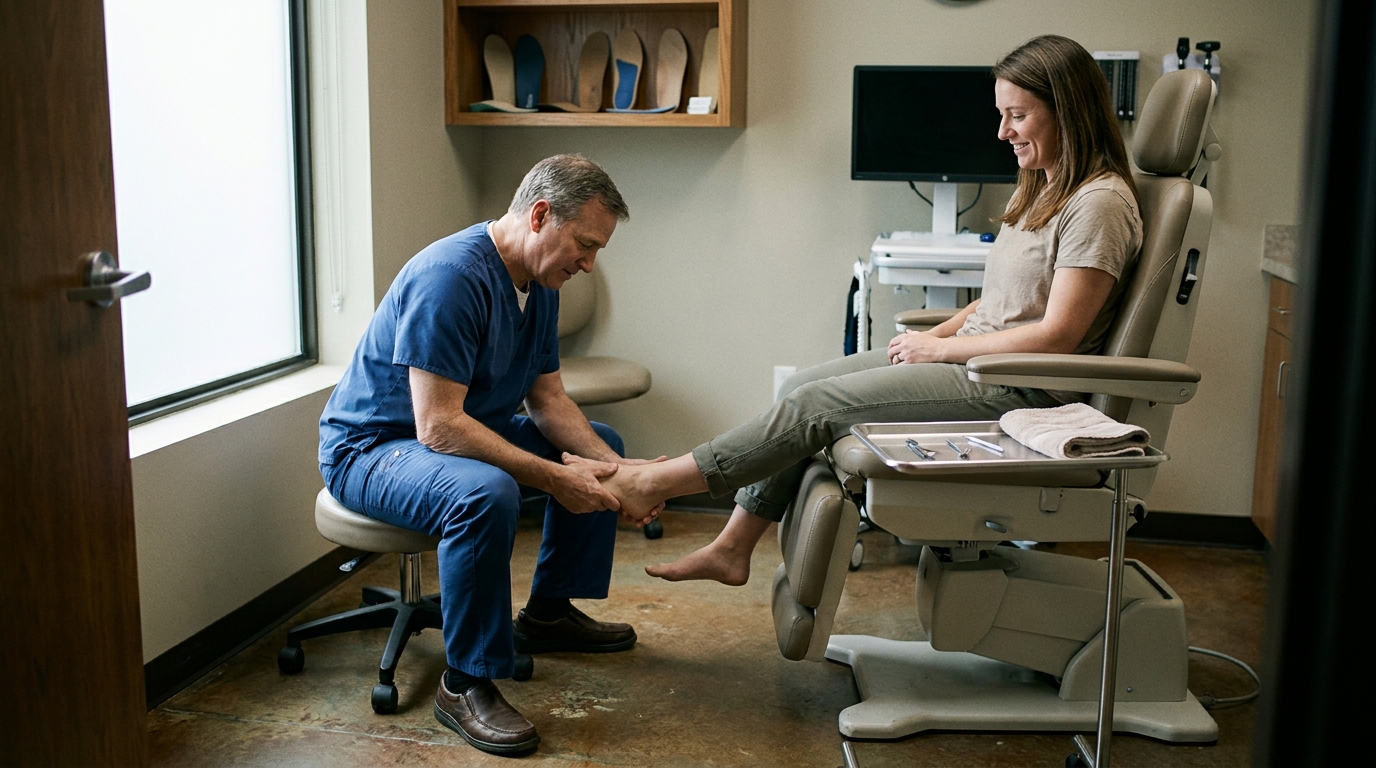
The nail-surgery review moment: when post-op relief becomes a 5-star review
Ask a nail-surgery patient for a review on the day of the procedure and you'll usually get nothing — their toe is numb, bandaged, and they're concentrating on getting home. Ask the same person five weeks later, the first time they walk normally in a proper shoe without thinking about it, and you'll get the most vivid review on your profile. Same patient. Same procedure. Completely different answer.
TL;DR
The review moment for nail surgery isn't the procedure — it's the settled-and-healed point, usually around weeks four to six, once the site has closed over and the patient is back in normal footwear. That's when the months of pain they lived with beforehand become the story they want to tell. Ask before then and you're interviewing someone mid-dressing-change. Nail-surgery reviews are also the most commercially valuable words on a podiatry profile, because patients write the exact phrase the next sufferer types into Google — and there's a clear exclusion set that should never receive the ask at all.
Why is the day of the procedure the wrong time to ask?
Because nothing has resolved yet. The patient arrived with a problem they'd tolerated for months — sometimes years — and what they leave with is a numb toe, a dressing, footwear advice, and a small amount of anxiety about how it's going to feel when the local wears off. Whatever gratitude they feel is genuine but provisional. They can't yet tell you the thing that would make a great review, because they don't know it yet.
That's the difference between satisfaction and relief — and it's the reason a generic "ask 24 hours after the appointment" rule quietly wastes your best cohort. Satisfaction is what a patient feels about the appointment. Relief is what they feel about their life afterwards. Reviews written from relief are longer, more specific, and far more persuasive to the next person reading.
- Day 0: anaesthetised, dressed, focused on aftercare instructions. No verdict available.
- Days 1–3: the most uncomfortable stretch, keeping the foot dry and elevated. Absolutely the wrong moment.
- Week 1 redressing: reassurance, not resolution — the patient is being told it's progressing normally.
- Weeks 2–3: healing well, still managing dressings and footwear. The story isn't finished.
- Weeks 4–6, at or just after discharge: healed, back in normal shoes, pain gone. This is the moment.
What does the nail-surgery healing timeline actually look like?
Exact healing varies with the technique, the toe, and the patient — but the shape is consistent enough to build a timing rule on. A partial nail avulsion with chemical matrixectomy generally means a wound that takes several weeks to close fully, with reviews along the way. What matters for our purposes isn't the clinical detail; it's where the emotional arc peaks relative to it.
- Procedure. Relief is intellectual, not felt. The patient trusts you; they don't yet have evidence.
- First week. Dressing management, keeping it dry, limited footwear. This is the period where a patient's confidence is lowest and where any complication would show — one more reason not to be asking for public feedback.
- Weeks two to three. Discomfort has gone, the site is closing, normal activity is creeping back. Warm, but the patient is still narrating it as "healing."
- Weeks four to six. Discharge territory. The site has settled, shoes are normal, and the patient has had a week or two of ordinary life to notice the absence of the pain they'd stopped noticing was there. This is where the review lives.
- Beyond eight weeks. The problem has been solved so completely that they've stopped thinking about it. Gratitude fades into normality and response rates fall away.
There's a real window here, and it's narrower than most clinics assume — a few weeks wide, opening later than any generic review tool would default to and closing sooner than "whenever we get around to it." That's exactly the sort of thing a cohort-aware system handles and a one-size-fits-all one can't. It's the same principle we apply across every podiatry cohort in timing the review ask in podiatry — nail surgery is simply the cohort where the gap between "appointment finished" and "outcome known" is widest.
Want this mapped against your own caseload?
On a 15-minute call we'll look at your appointment mix — nail surgery, orthotics, sports, chronic care — and show you which cohorts are being asked at the wrong moment and what that's costing you in reviews.
Book a 15-minute strategy call →Why are nail-surgery reviews worth more than your other reviews?
Here's the part that isn't obvious until you've read a few thousand podiatry reviews. Nail-surgery patients don't write vague praise. They write the story: how long they put up with it, what they tried first, how nervous they were about the needle, and how they wish they'd come in a year earlier. Which means they naturally write the exact words the next sufferer is typing into Google.
- They use the search term. "Ingrown toenail" appears in the review because it's how the patient describes their own problem. That's high-intent local vocabulary landing on your profile for free.
- They pre-answer the objection. Nearly every one mentions that it hurt less than expected — which is the single thing keeping the next patient from booking.
- They're emotionally legible. "I should have done this two years ago" converts better than any marketing line you could write, and you couldn't write it anyway.
- They arrive from a decisive cohort. Someone who finally booked a procedure they'd delayed is a person who follows through — including on a review request.
That vocabulary effect matters beyond the individual review. Google reads the language attached to your profile when deciding which searches you're relevant to, so a steady flow of reviews describing ingrown toenails, nail surgery and pain relief pulls you toward exactly those searches. We break the mechanic down in how the Google local pack ranks podiatry clinics.
What the base shows: 99% of happy patients never leave a review unless they're asked properly, and clinics that switch from ad-hoc asking to a consistent, cohort-timed one see a 6 to 13× lift in new monthly reviews. In allied health specifically, the procedural cohorts — nail surgery above all — punch well above their share of the appointment book, because the outcome is unambiguous and the patient can feel it.
Who should never receive the nail-surgery review request?
This is the part that has to be built in before you turn anything on, and it's non-negotiable. The ask goes to every eligible patient the same way — and eligibility is a clinical judgement, not a guess about who's likely to say something nice.
- Anyone with a wound complication. Delayed healing, infection, regrowth, an unplanned return visit — these patients are still in care, and a review request lands as tone-deaf.
- High-risk feet. Patients with diabetes, neuropathy or vascular compromise are managed on a different timeline with a different risk profile. Their nail surgery isn't a tidy six-week story and shouldn't be treated like one.
- Anyone still under active management. If the file isn't closed, the ask waits.
- Anyone who's raised a concern. They go to the private feedback channel and a phone call, in that order.
And the other half of doing this decently: every patient gets offered the private route as well, not just the ones you suspect are unhappy. Same ask, same patients, two doors — one to Google, one to your inbox. The full exclusion map for the clinic sits in who NOT to ask for a review in podiatry.
How do you run this without adding work at the front desk?
Honestly, this surprises most clinic owners: the timing rule is the easy part, and it's the tracking that kills it manually. Nobody at reception is going to remember on a Thursday in five weeks' time that Tuesday's nail surgery patient is now due for an ask — not while the phone is ringing and there are three people at the counter.
So the mechanism has to run off something the clinic already does. Your practice management software already knows the appointment type and the date, whether that's Cliniko, Power Diary, Halaxy, Nookal or TM3 — and any system that can fire an automated reminder can fire a review request on the same logic. The setup is:
- Tag the appointment type. Nail surgery is its own cohort, not "podiatry consult."
- Set the delay to the outcome, not the appointment. Four to six weeks out, ideally anchored to the discharge review rather than the procedure date.
- Gate it on the exclusion set. Complications, high-risk feet and open files drop out automatically before anything sends.
- Send it as the clinic. The message should read as if it came from the practice the patient has just spent six weeks with — because it did.
- Offer both doors every time. Public review or private feedback, patient's choice, every patient.
Set up once, it runs quietly in the background — the front desk does nothing, and the reviews arrive from patients at the exact moment they're most glad they came in. If you want to see the full cohort-by-cohort version, it's in the podiatry new-patient engine, and there's a worked example of the compounding in how a regional NSW clinic added 267 reviews in six months. Happy to share specifics on a 15-minute strategy call →
What does a well-timed nail-surgery ask actually change?
Take a composite from the customer base — a two-podiatrist clinic in a regional AU town doing eight to ten nail procedures a month alongside a general caseload. Before: reviews arrived accidentally, maybe three a month, and the profile sat at 4.6 with the newest review a month old. The nail-surgery patients, the clinic's most grateful cohort, were being asked (if at all) two days post-procedure and almost never responded.
- The ask moved to the discharge review, four to six weeks out, with the exclusion set live.
- Response from that cohort rose sharply — an unambiguous outcome asked about at the moment the patient can feel it converts far better than a generic post-appointment nudge.
- Across all cohorts the clinic added 178 reviews over five months and moved from 4.6 to 4.9.
- The profile filled with the words "ingrown toenail," "painless" and "wish I'd come sooner" — which is precisely what the next sufferer searches and reads.
Nothing about the clinical work changed. The clinic was already excellent at this procedure — the reviews had simply been asked for at the wrong point in the story. That's the whole intervention, and it's the same reason the silent majority stays silent everywhere else: not reluctance, just a badly-timed prompt. See the silent 99% of podiatry patients for the wider version.
The reframe: your nail-surgery patients aren't reviewing a procedure — they're reviewing the end of a problem they carried for months. Ask them while the toe is still bandaged and you get silence. Ask them the week they forget to think about it, and you get your best review of the quarter.
Frequently asked questions
When should you ask a nail-surgery patient for a review?
At or just after discharge — typically four to six weeks post-procedure, once the site has settled and the patient is back in normal footwear. That's when the relief becomes something they can feel and describe. Asking on the day or in the first fortnight catches them mid-healing, when they have no verdict to give.
Why do nail-surgery patients write better reviews than other podiatry patients?
Because the outcome is unambiguous and they lived with the problem for months first. They tend to write the whole story — how long they put up with it, how nervous they were, how much less it hurt than expected — which is exactly what the next sufferer needs to read, in the language they'd search with.
Should diabetic patients having nail surgery be asked for a review?
No — high-risk feet, including patients with diabetes, neuropathy or vascular compromise, should sit outside the automated ask. Their healing runs on a different timeline with a different risk profile, and they're usually still under active management. Offer the private feedback channel instead, as you would for every patient.
What if a nail-surgery patient had a complication?
They come out of the ask entirely. Delayed healing, infection, regrowth or an unplanned return visit all mean the patient is still in care, and a review request at that point is tone-deaf. The private feedback route and a phone call are the appropriate response.
Can this be automated through my practice management software?
Yes. Any system that can send an automated reminder can trigger a review request off the same appointment data — Cliniko, Power Diary, Halaxy, Nookal and TM3 all carry the appointment-type and date fields needed. The cohort delay and the exclusion rules sit on top, so nothing lands at the front desk.
Is asking for a review after a procedure appropriate in allied health?
Asking for honest feedback is fine when it's done consistently and clinically appropriately — every eligible patient asked the same way, the vulnerable and complicated cases excluded, and a private channel offered to everyone. What you do with reviews afterwards is a separate question: in Australia, testimonials shouldn't appear in advertising for a regulated health service, so leave them where the patient posted them.
Ask at the moment they feel it — not the moment you saw them.
Fifteen minutes. We'll map your appointment types to the windows that actually convert, show you which cohorts are being missed, and walk through the exclusion set — start with the podiatry playbook library or the Review Engine for podiatry clinics.
Book a 15-minute strategy call →
Leeor Meirovitz
Leeor's spent the last few years inside hundreds of independent vet clinics across the AU, NZ, UK, US, CA, TH, and PH markets — what actually moves Google ranking, what corporate chains can't replicate at the per-location level, and how the silent 99% of happy clients become the practice's loudest reviewers. He writes the way he talks at strategy calls: friendly, specific, and slightly opinionated.